Lincoln Ave Cat & Dog Hospital
ORAL & JAW SURGERY
Surgical extractions, oral masses, jaw fractures, and palate repair for dogs and cats in Bergen County. Dental X-rays and surgery in one hospital.
Pets Hide Mouth Pain Well
Dogs and cats with painful mouths almost always keep eating, they chew on the other side, swallow food whole, or simply tolerate it. Eating is not evidence that nothing is wrong.
Most of what causes oral pain sits below the gumline, where it can't be seen during a conscious exam. Finding it takes dental X-rays under anesthesia.
Full-mouth dental X-rays
35 years of surgical experience
Diagnostics and surgery in one hospital
Local nerve blocks and take-home pain control
No referral needed
Independent, doctor-owned hospital
Available treatment varies according to the species and condition.
★★★★★ 4.6 · 425+ Google Reviews
Does My Pet Need Oral Surgery?
Meet with a doctor to examine the mouth, review what the X-rays show, and understand which teeth or tissue actually need to come out and which don't.
A broken, loose or badly damaged tooth.
Any lump, growth or sore in the mouth that isn't healing.
Swelling below an eye, or along the jaw.
Pawing at the face, or reacting when the muzzle is touched.
Dropping food, or chewing only on one side.
A cat that has stopped eating, or is drooling.
Difficulty opening or closing the mouth.
Second opinion.
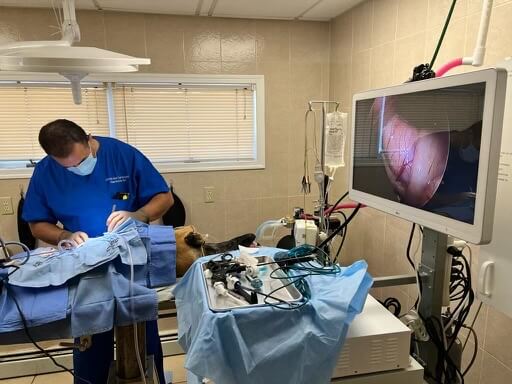
In-House Diagnostics and Surgery
Start with an examination and understand the diagnosis before making a treatment decision.
Diagnosis & Surgery in One Hospital
More than half of every tooth sits beneath the gumline, and the same is true of the disease that affects it. A tooth that looks sound can have an abscessed root. A mass that looks small on the surface can extend into bone. X-rays are what turn a guess into a plan.
Full-mouth dental radiographs
Surgical and incisional biopsy
Digital X-rays for jaw and skull
Oral biopsy and cytology
Bloodwork before anesthesia
Continuous anesthesia monitoring
X-rays are taken while your pet is already under anesthesia, so the findings and the treatment happen in the same visit.
Oral & Jaw Procedures We Perform
What the mouth needs is decided after the X-rays, not before.
The plan is discussed with you before anything is removed.
Surgical Extractions
Not every tooth comes out the same way.
A simple extraction lifts a tooth free. A surgical extraction is needed when a root is fractured, fused to bone, or belongs to a large multi-rooted tooth the gum is opened, a small amount of bone is removed, the tooth is sectioned, and the site is closed with sutures.
Where a tooth can be saved instead, we'll say so. Tooth-preserving options are covered under Dentistry.
Surgical and simple extractions
Fractured, abscessed and retained roots
Local nerve blocks during the procedure
Sutured closure and take-home pain control
Feline Stomatitis & Tooth Resorption
Two conditions that affect cats and almost nothing else, and both end in extraction. In tooth resorption, the tooth structure breaks down from the inside and is gradually replaced by bone. It is painful, cannot be reversed, and cannot be filled or repaired. X-rays determine which teeth are affected and how, and removal is the treatment.
Stomatitis is severe, whole-mouth inflammation in which the immune system reacts to the teeth themselves.
Extraction of resorptive lesions
Caudal or full-mouth extraction for stomatitis
Extended pain management during recovery
Feeding guidance for the weeks afterward
Oral Masses & Tumors
Growths in the mouth need identifying early. Some are benign and slow-growing. Others are among the more aggressive tumors in dogs and cats, and they behave very differently from one another, which is why a biopsy comes before any decision about removal.
Oral biopsy and staging
Mass removal with margins
Partial mandibulectomy or maxillectomy when indicated
Full pathology on everything removed
Coordination with a veterinary oncologist when appropriate
Jaw Fractures & TMJ
The jaw is not repaired like other bones. Tooth roots occupy most of the mandible, so plates and screws often aren't the right choice. Many jaw fractures are stabilized instead with wiring and a composite splint bonded to the teeth, which holds alignment without damaging the roots.
We also assess the temporomandibular joint (the hinge of the jaw) in pets who can't open or close the mouth normally, or whose jaw locks or clicks.
Interdental wiring and composite splinting
Repair of trauma-related fractures
Temporomandibular joint assessment and treatment
Jaws weakened by advanced dental disease
Follow-up imaging to confirm healing
Palate, Lip & Salivary Gland Surgery
Defects that connect the mouth to places it shouldn't. An oronasal fistula is an opening between the mouth and the nasal cavity.
Cleft palates are present from birth and are repaired once a puppy or kitten is old enough. Salivary mucoceles (swellings caused by saliva leaking into surrounding tissue) are treated by removing the affected gland.
Oronasal fistula repair
Cleft palate repair
Salivary mucocele and ranula treatment
Lip fold and lip laceration repair
About Anesthesia
This is the question we're asked more than any other, usually about an older pet.
Every procedure on this page requires general anesthesia. There is no version of oral surgery, or of a meaningful dental X-ray, that happens with a conscious animal.
Age is not a disease. A healthy twelve-year-old is often a better anesthetic candidate than a sick four-year-old. What matters is the individual patient, which is why bloodwork comes first, why an IV catheter is placed, why heart rate, blood pressure, oxygen and temperature are monitored throughout, and why local nerve blocks are used so that less general anesthetic is needed.
If your pet has a heart condition, kidney disease or another concern, tell us.
FINANCING OPTIONS WE WORK WITH


Trusted by Fair Lawn Pet Parents
Read how Dr. El-Akbawy and our dedicated team have transformed the lives of pets across Bergen County.
Proud Members & Accreditations:
AAHA Accredited
AVMA Member
NJVMA
Ready to Schedule Your Pet's Visit?
Dogs, cats, and exotics, cared for on Lincoln Avenue Hospital.
Ask for same-day appointments, no referral needed.
Lincoln Ave Cat & Dog Hospital
Family-owned and independently operated on Lincoln Avenue since 1984.


Hours
Mon, Tue, Thu, Fri: 9 - 5pm
Wed: 12pm - 7pm
Sat: 9 - 2pm
Sun: Closed
© 2026 Lincoln Ave Cat & Dog Hospital. All rights reserved. · Privacy · Terms of Service · Accessibility
Serving Fair Lawn, NJ and Bergen county since 1984.